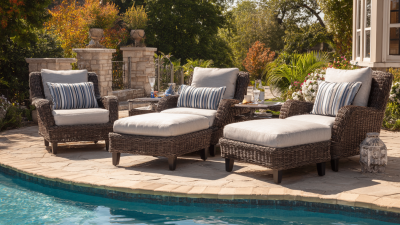
2026 Top Outdoor Tables for Global Buyers
In 2026, outdoor living continues to influence hospitality, residential, and commercial design worldwide. Outdoor Tables now serve more than casual dining. They shape comfort, traffic flow, visual identity, and long-term maintenance costs. Global buyers need products that perform across changing climates and demanding environments.
This guide examines leading table options through practical purchasing criteria. We consider aluminum, teak, stainless steel, recycled plastic, compact laminate, and mixed-material designs. Each material responds differently to sunlight, moisture, salt air, temperature changes, and frequent cleaning. A coastal café may need corrosion-resistant frames, while a dry resort may prioritize UV stability and low water use. Details matter.
So does testing.
We focus on frame strength, surface durability, hardware quality, edge finishing, assembly, packaging, and replacement support. We also consider realistic shipping conditions, including stacked cartons, warehouse storage, and final-site installation. Product claims should be checked against technical documents, independent testing, and clear supplier communication. A polished photograph is not enough.
No table fits every market.
The strongest choice depends on climate, usage frequency, budget, available maintenance, and local design preferences. Buyers should compare dimensions carefully, especially when chairs, umbrellas, or wheelchair access are involved. Small measurement errors can create expensive problems. We also recognize that sustainability claims require evidence, not attractive wording. Certifications, recycled content, responsible timber sourcing, and repair options deserve verification.
This overview is designed to support informed sourcing decisions. It offers professional guidance, but conditions vary. Even a highly rated model may disappoint in the wrong setting. Careful sampling remains essential before large-scale purchasing.
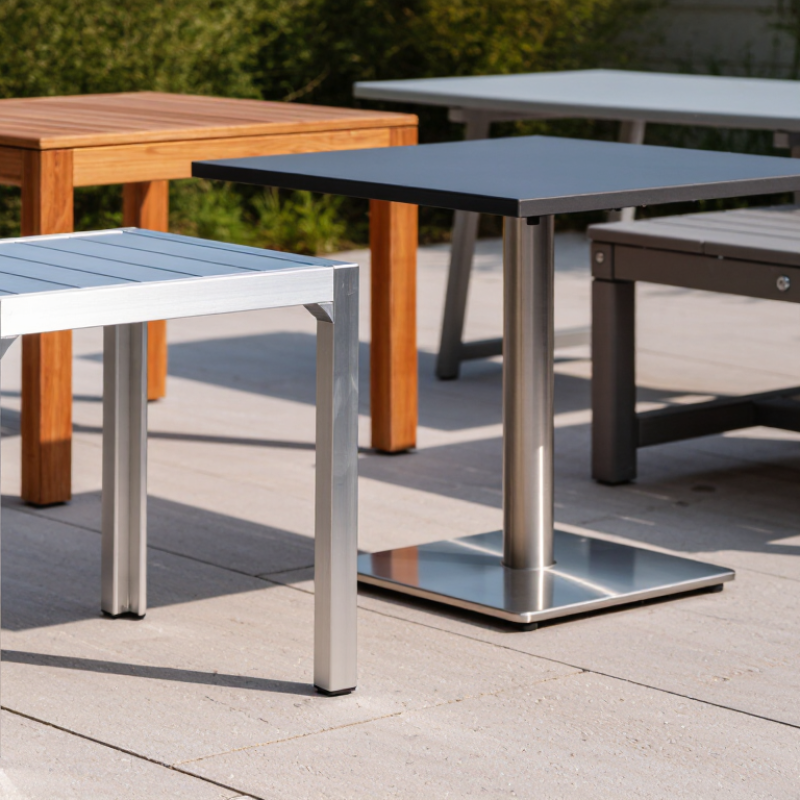
2026 Market Scope: Outdoor Table Categories, Uses, and Global Buyer Needs
Outdoor tables are moving beyond simple patio furniture in the 2026 global market.
Buyers now compare dining tables, coffee tables, bar tables, folding tables, and compact balcony models by use, climate, and maintenance needs. A coastal resort may require corrosion-resistant frames, while an urban café may prioritize narrow footprints and quick cleaning.
Material selection needs practical judgment. Powder-coated aluminum offers low weight and useful rust resistance. Teak and other dense hardwoods provide warmth, but they need regular care in harsh weather. Recycled plastic can suit public spaces because it tolerates moisture and frequent use.
No material is perfect. Surface heat, fading, drainage, and repair access still require checking.
Global buyers also examine packaging, assembly, load capacity, and replacement parts.
A table shipped across climates should protect corners and control moisture inside cartons. Commercial users often need stable bases, rounded edges, and easy-to-clean surfaces. Residential buyers may prefer nesting designs or adjustable legs for uneven patios.
Product testing should reflect real conditions, not only showroom appearance. Small details matter. A poorly placed drain hole can leave water after rain. Clear specifications, consistent quality checks, and documented material information help buyers make safer, more reliable purchasing decisions.
Material Metrics: Aluminum 2,700, Teak ≈650, HDPE ≈950 kg/m³
2026 Top Outdoor Tables for Global Buyers
Material density changes the buying decision before styling begins. Aluminum weighs about 2,700 kg/m³, according to The Aluminum Association’s Aluminum Standards and Data. Teak measures approximately 650 kg/m³ in FAO forestry references. HDPE commonly reaches about 950 kg/m³, consistent with ASTM D792 density testing ranges.
Consider a 1.2-by-0.7-meter tabletop, 40 millimeters thick. Its volume is 0.0336 m³. A solid aluminum panel could weigh nearly 91 kilograms. Teak would weigh about 22 kilograms. HDPE would approach 32 kilograms. Real tables use frames, ribs, and hollow sections. Construction changes the final weight significantly.
Density alone misleads.
In field purchasing, I check leg geometry, fasteners, drainage, and lifting points. A lighter aluminum frame may still feel stable when properly braced. HDPE offers useful mass, but thermal expansion needs allowance around joints. Teak provides lower density and a warmer surface, yet moisture content can alter its shipping weight.
FAO reports that teak density varies with origin and wood condition. ASTM D792 also measures specific gravity under controlled conditions, not every outdoor climate. That difference matters. Buyers should request moisture data, wall thickness, alloy details, and complete-table weight. I would avoid comparing material prices by volume alone. Freight charges usually follow mass, packaging, and container efficiency. A spreadsheet can reveal savings, but a sample table exposes the mistakes.
2026 Top Outdoor Tables for Global Buyers - Material Metrics: Aluminum 2,700, Teak ≈650, HDPE ≈950 kg/m³
Practical material comparison for outdoor table sourcing and specification
| Material |
Typical Density
(kg/m³) |
Outdoor Performance |
Moisture & Corrosion Behavior |
Maintenance Level |
Best Use Cases |
| Powder-Coated Aluminum |
≈2,700 |
Lightweight, rigid, and suitable for frequent relocation |
Naturally corrosion-resistant; coating improves appearance and surface protection |
Low; clean regularly and inspect coating for chips or scratches |
Hotels, restaurants, balconies, terraces, and commercial outdoor dining |
| Teak |
≈650 |
Naturally durable hardwood with strong outdoor appeal |
Good resistance to moisture due to natural oils; may weather to silver-gray |
Medium; periodic cleaning, with oiling optional for color retention |
Premium gardens, resorts, patios, and long-life outdoor furniture |
| HDPE |
≈950 |
Impact-resistant, lightweight compared with wood, and suitable for humid climates |
Very low water absorption; does not rust or rot |
Low; soap-and-water cleaning is usually sufficient |
Pool areas, family dining, coastal locations, and high-use hospitality spaces |
| Stainless Steel 304 |
≈8,000 |
High strength and excellent dimensional stability |
Good general corrosion resistance; stronger coastal or salt exposure may require higher-grade steel |
Low to medium; remove salt and chlorides from the surface |
Commercial terraces, high-traffic venues, and contemporary outdoor designs |
| Acacia Hardwood |
≈600–800 |
Good strength-to-weight balance and warm natural appearance |
Moderate outdoor durability; requires proper sealing and drainage |
Medium to high; resealing is recommended according to exposure |
Residential patios, cafés, covered terraces, and value-oriented collections |
| Tempered Glass |
≈2,500 |
Rigid, heat-resistant, and visually light; requires careful edge protection |
Unaffected by rust and rot; surface may show water spots |
Low; clean with non-abrasive glass products |
Modern patios, dining terraces, and mixed-material table designs |
Technical note: Density values are typical reference values for the material itself, not the finished table. Actual product weight depends on dimensions, wall thickness, frame construction, moisture content, hardware, coatings, and glass thickness. Teak and acacia values vary with species, grade, and moisture condition.
Durability Testing: ISO 4892-3 UV Exposure and ASTM D570 Water Absorption
2026 Top Outdoor Tables for Global Buyers
Durability Testing: ISO 4892-3 UV Exposure and ASTM D570 Water Absorption
Outdoor tables face more than sunlight. Moisture enters edges, joints, and cut surfaces. ISO 4892-3 testing exposes material samples to controlled fluorescent UV radiation, condensation, or water spray. The selected cycle should reflect the table’s intended environment, not a convenient laboratory routine.
During evaluation, inspectors record color change, cracking, chalking, warping, and surface brittleness. Small details matter. A pale panel may look acceptable while its fastener area weakens. We also measure dimensional changes before and after exposure. Photographs, exposure hours, lamp conditions, and sample preparation should remain traceable.
ASTM D570 helps assess water absorption in plastic components and composite materials. Samples are weighed, conditioned, immersed under specified conditions, then weighed again. Increased mass may indicate moisture uptake. That moisture can affect stiffness, swelling, bonding, and freeze resistance. Edge sealing must be documented, because unfinished edges can produce misleading results.
A practical purchasing review should connect both tests. UV exposure may damage a surface, allowing water to enter faster. Water absorption can then worsen cracking or distortion. One test alone is not enough. Our early assumption was that low absorption guaranteed outdoor reliability. It did not. Joint design, drainage, coating adhesion, and thermal movement still require inspection. Test data supports decisions, but it cannot reproduce every coastal, tropical, or high-altitude climate.
Safety Standards: EN 581-2 Stability, Strength, and Durability Requirements
For global buyers, the top outdoor tables should be assessed against EN 581-2, not appearance alone. This European standard addresses mechanical safety requirements and test methods for outdoor tables used in camping, domestic, and contract settings. A table can look rigid and still fail.
Stability testing examines resistance to tipping under controlled loading. Check the base width, leg position, adjustable feet, and uneven-floor performance. Strength testing evaluates structural parts under specified forces, including the tabletop, supports, joints, and connection points. Inspect welds and fasteners closely. Small movement may become a serious problem after repeated use. Durability testing applies repeated loads or impacts to reveal loosening, cracking, and permanent deformation. Ask for test reports linked to the exact model and configuration.
Details matter here. A heavy tabletop does not guarantee safe performance. Hollow legs may reduce weight, but weak joints can undermine the frame. Folding mechanisms need careful inspection, especially around locking points and pinch areas. The standard focuses on mechanical safety, so it does not automatically prove resistance to ultraviolet exposure, moisture, salt air, or rust. Separate material and weathering assessments remain important for coastal projects. That gap is easy to overlook. Supplier documents should identify dimensions, load conditions, test methods, and production controls. Random sample checks are useful because factory consistency is never perfect. A practical buyer should also repeat basic stability checks on delivered units, since transport and assembly can change performance.